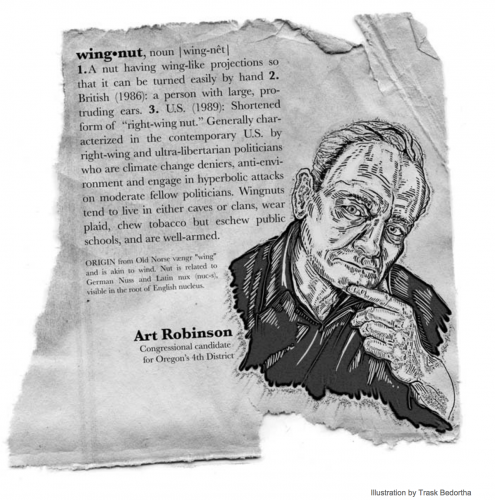
We may have reached peak oil, but has the U.S. reached peak wingnut? Peak oil, if you don’t know already, is the idea that the world’s finite crude reserves have maxed out and we are on the downhill side of using the last half of the world’s currently extractable oil.
Peak wingnut is the more hopeful theory that we have reached the summit in how many rightwing crazies are going to enter into the current political scene, or in this case Oregon politics.
The recent rise of the Tea Party (aka the Teabaggers) could be a sign that we’ve hit peak wingnut. Or maybe a truer sign is Art Robinson’s current campaign against Rep. Peter DeFazio for Oregon’s 4th District congressional seat, already characterized by threats of chicken suits and some name calling.
Wingnut, in reference to politics, seems to have arisen in about 1989 from the expression “right-wing nut job.” Before that the word was pretty exclusively used to describe that metal thingy with the ears sticking out that goes on a screw or, in England, a guy with big ears. It’s the opposite of the lesser-known slur used against liberals — moonbat. Recent elections have also brought us useful words like wackadoodle in reference to some of the more special candidates, or as DeFazio describes Robinson, “off the edge of the flat Earth.”
David M. Herszenhorn in a 2009 New York Times column defined a wingnut as “a loud darling of cable television and talk radio whose remarks are outrageous but often serious enough not to be dismissed entirely.”
Robinson is hardly a cable and radio darling, but this isn’t the first time his name has made it into the news. In fact one might point to his significant scientific credentials and argue he’s not a wingnut at all. The man has a Ph.D. in chemistry, worked with two-time Nobel-Prize winner Linus Pauling, developed a successful home schooling curriculum and has raised almost $400,000 for his campaign against DeFazio. He won the Republican and Independent party primaries, and garnered the nominations of the Constitution and Libertarian parties.
The congressional candidate also believes that a little nuclear radiation is good for you, human-caused global warming doesn’t exist, the pesticide DDT that almost wiped out bald eagles should never have been banned and that public schools should be abolished, calling them “nationalized child-abuse” on his Robinson Curriculum webpage.
A glance at Robinson’s campaign funding reveals that most of the money he’s raised has come from out of state. The April and July quarterly reports to the feds show that there are 303 out-of-state versus 54 in-state contributions. Some of those contributions come from Tea Partiers, and many from people with ties to chemical interests. DeFazio’s money is primarily in-state and some comes from the unions. DeFazio has raised money from Native American tribes. Robinson has paid $8,500 to David Jaques of Roseburg for political consulting. Jaques is the president of One Nation United, a group Native American news source Indian Country Today calls anti-Indian and bigoted.
This election season saw incumbent Susan Castillo only narrowly beat out R-G-endorsed anti-abortion, anti-gay, anti-evolution, anti-affirmative action, pro-guns and prayer-in-the-classroom Republican Ron Maurer for the state superintendent of schools position. It also saw local Tea Partier Jay Bozievich — also pro-guns at schools and known to dress up in a wig and colonial soldier outfit — stay in the race against Jerry Rust for the West Lane Commissioner’s seat. So it seems that being a bit of a wingnut isn’t holding anyone back from running for public office in this state.
The Terminator is still the Governator of California, former Fugees singer Wyclef Jean has thrown his hat in the ring to be president of Haiti, unknown and unemployed Alvin M. Greene won South Carolina’s Democratic primary for U.S. Senate and people are still taking Sarah Palin seriously.
Nervous yet?
Art Robinson, aka Dr. Arthur B. Robinson
Candidate Art Robinson is also known as Dr. (or professor) Arthur B. Robinson, and when you talk to him he sounds exactly like the university professor he once was. He’s got that avuncular sort of scientific but friendly tone, which makes you think of Sir David Attenborough narrating the scene in the BBC’s “Life on Earth” nature series where he meets the mountain gorillas, just not with a British accent. Trouble is, what Robinson’s saying is more reminiscent of the John Hammond character played by David’s brother Richard Attenborough in Jurassic Park — you know the guy who brings dinosaurs back to life. His science seems solid, and yet a little wackadoodle all at once.
Robinson offers his life story in a brochure distributed to Lane County voters. He’s the son of Ted Robinson, who designed the Union Carbide chemical plant in Texas as well as in Puerto Rico, Brazil, Scotland, England, Belgium, India and Japan. Union Carbide is best known as the chemical giant whose pesticide plant in India leaked in 1984 and killed thousands of people, with an estimated half million injuries.
Ted Robinson died in a plane crash in 1966, and Art Robinson and others have speculated (in a conspiracy-theory sort of way) that the crash was orchestrated by the CIA to kill Indian nuclear scientist Homi J. Bhabha, who was also on the plane.
Shortly after his father’s death and his mother’s subsequent suicide, Art Robinson graduated UC San Diego with a Ph.D. in chemistry and became a professor there. He left and joined Linus Pauling, winner of Nobel Prizes in chemistry and in peace, in founding the Linus Pauling Institute of Science and Medicine in 1973. According to his brochure, Robinson assumes that their medical discoveries will soon be available to the American people. But, the brochure says, “He is naive. The tentacles of Washington politicians have already reached into American medicine — choking off innovation.”
The institute still exists, now at Oregon State University, but Robinson and Pauling fell out in the late 1970s. Robinson has said it was because his experiments proved wrong Pauling’s theories on the efficacy of vitamin C. He sued the institute and various members and trustees for $25.5 million. They later settled for $575,000. Robinson mentions his relationship with Nobel laureate Pauling in the brochure, but not the falling out, nor the lawsuit.
Robinson went on to found his own institute: the Oregon Institute for Science and Medicine, or as his detractors have labeled it, the Oregon Institute for Science and Malarky. Of the eight faculty members listed, two are Robinson’s sons and two are dead.
Educational Issues
After Robinson’s wife died in 1988, the widower raised the couple’s six children on their farm in Cave Junction. Or rather, the brochure says, “The Lord raised the children, Art ran errands.”
Robinson home schooled the children. He developed the Robinson Curriculum, which is sold for about $200 on the internet. It worked for his kids — two are veterinarians, one has a Ph.D. in chemistry and three of them are getting their doctorates in nuclear medicine at OSU. Robinson says on the website that he began home schooling the children because, “the social and religious environment in most schools in America has deteriorated to a level of evil such that it is a threat to the spiritual, moral and mental health of each child who is forced to participate in it.”
Robinson has called repeatedly for abolishing public education in his newsletter Access to Energy. The Robinson Curriculum website says, “There is a growing possibility that, if the home schooling movement continues to expand, it may become the most important single force that Christians can employ to take America back from the anti-Christian forces that currently control American public life.”
The curriculum is on a set of 22 CDs that include a 1911 encyclopedia, the King James Bible and a collection of books no longer under copyright. Robinson’s attacks on multiculturalism, as well as the curriculum’s use of books with bigoted passages, have led to accusations of racism.
An article on AlterNet says Robinson has been “reprinting, marketing and selling a virulently racist 19th Century English boys’ adventure novel that suggests Africans are like retarded children.” The article points to a PBS criticism of author G.A. Henty that says, “Henty’s books are notable for their hearty imperialism, undisguised racism and jingoistic patriotism.”
Robinson contends that the passage reading “the intelligence of an average negro is about equal to that of a European child of ten years old” was pulled out of context. The rest of the book is an adventure with the explorers’ bags being carried by cannibals and encounters with a tribe that uses white tablecloths and silverware. He says the book is actually an argument against slavery, and points out that the curriculum also publishes the autobiography of Booker T. Washington.
In response to these accusations and to criticisms of his calls to abolish public schools and diatribes calling them “tax financed racism,” Robinson says, “I never planned to run for office, or I would have looked at every word I wrote.” Robinson has denied authorship of some of the statements in the newsletter he has been responsible for creating for the past 17 years.
DeFazio calls this perspective “reconstructionist,” and says that Robinson “is well off the edge of the flat Earth on the question of public education and is trying to reconstruct himself as someone who is merely critical is false.”
Global Warming?
In a recent letter to DeFazio Robinson writes that he has published six peer-reviewed articles in the Proceedings of the U.S. National Academy of Sciences and asks, “Are you even capable of writing any article that would be suitable for consideration by that journal?” In the same letter he accuses DeFazio of “hiding behind the skirts of the League of Women Voters.” Robinson refuses to be part of any debate scheduled by that group, implying they would mollycoddle DeFazio.
With articles like “Prediction of Protein Deamidation Rates from Primary and Three-Dimensional Structure” and “Evolution and the Distribution of Glutaminyl and Asparaginyl Residues in Proteins,” Robinson’s scientific background appears impeccable, but some of his scientific theories are a little, well, wackadoodle.
Robinson is an advocate for nuclear power and a proponent of radiation hormesis, a theory claiming that very low levels of radiation can be beneficial to humans. He writes in a 1997 issue of Access to Energy, “The most sensible use of low-level radioactive waste is as a concrete and insulation additive in residential homes — especially in areas where there is insufficient natural radiation for optimum health.” He told EW that a state like Oregon, with its lower radiation rates, suffers from higher cancer rates than Colorado, which has higher background radiation. The damage done at a very low level of radioactivity keeps the immune system in shape, he says. In response to a question regarding whether this is similar in principle to homeopathy, he says, “Homeopathy is so strange; it’s outside of my field of specialization.”
Both the National Council on Radiation Protection and Measurements and United Nations Scientific Committee on the Effects of Atomic Radiation say there is no evidence to support the theory of radiation hormesis. What has been proven is that high levels of radiation are indeed pretty bad for our health.
In one issue of Access to Energy, which Robinson has been editing and producing since 1993, Robinson writes, “If radioactive waste were dissolved as water soluble compounds and then widely dispersed in the oceans, no health or other environmental risks would ever occur.” In another issue he says the newsletter is “proudly printed on 100% unrecycled paper.”
An earlier issue of the newsletter, which Robinson credits to its founder Petr Beckmann, claims oil spills “are a boon to marine life, inflicting damage mainly on the oil and shipping companies. For crude oil is a natural, organic, biodegradable product of the earth’s ancient plant and animal life, and it is this type of hydrocarbon that marine life in the open and deep ocean is starved for.”
But Robinson is perhaps best known for his denial of global warming. He is responsible for the Oregon Petition, a document directed at the federal government insisting that global warming is an unproven hypothesis and requesting that the government reject the Kyoto Protocol. The project’s website says 31,487 American scientists have signed this petition, including 9,029 with Ph.D.s.
Critics counter that some of the signatures are known fakes, including one purporting to be a Spice Girl and another for Perry Mason.
Another criticism is that many science degrees involve no training in climatology. The National Academy of Sciences (NAS), the same group that has published Robinson’s peer-reviewed papers, disavowed the findings in the petition and the 12-page review that accompanied it, which critics say was misleadingly formatted to look like an NAS publication.
Robinson rejects the idea that humans are responsible for any warming of the earth’s atmosphere. He acknowledges that the atmospheric CO2 concentration is increasing, but, “If you like plants and animals, you should like CO2,” which he says is good for crops. He writes in Access to Energy, “The more hydrocarbons we burn, the more our natural environment will prosper … We are moving hydrocarbons from below ground and turning them into plants and animals — a wonderful and unexpected environmental gift from the human Industrial Revolution.”
The Debate
By most folks’ reckoning, DeFazio — who is running for his thirteenth term in office — is politically invulnerable. The fiery politician has faced down challengers before, notably Jim Feldkamp in 2004 and 2006. Right about the time people start grumbling that DeFazio’s a liberal, he does something like vote against President Barack Obama’s stimulus bill. He’s not afraid to go against the grain. “People don’t always agree with me,” DeFazio says, “but they know where I stand on issues, and I study the issues before I approach them.”
Robinson’s campaign leans on the idea that DeFazio has been in office too long. “I have been there a while,” DeFazio says, “and there’s people who arrived last year who never should have been elected; there’s people who have been there too long and who have gotten stale on the job and corrupt; there’s other folks who continue to be vital and put forward good ideas, and I put myself in that last category.”
During a July 13 talk to a group of Eugene 9/12ers at Harris Hall downtown, Robinson called DeFazio a “screaming socialist.”
When apprised of Robinson’s description, DeFazio laughs. “If we’re to exchange labels, I could come up with some extraordinary descriptions of him, but I will refrain from that,” he says.
“I’m member of the Populist Caucus, a member of the Progressive Caucus, and I’m also the co-chair of the House Craft Brewing Caucus. I have a pretty wide portfolio, but none of it includes ‘screaming socialist,’” he adds.
Of Robinson’s platform, DeFazio says, “His polices reflect all the failures of the past. That’s not new and different.”
Robinson has complained that DeFazio won’t face him in a debate. Robinson is demanding there be seven debates in seven counties, in homage to the 1858 Lincoln-Douglas debates.
“He wants to have debates at times and places of his choosing, with his format — which is totally bizarre. He would talk for three minutes; I would talk for three minutes; he would talk for three minutes,” DeFazio says, “with no questions from the audience and then, after two hours, after everyone has left, he would take questions from the audience.” For his part, DeFazio has scheduled four debates: one at the Eugene City Club, one sponsored by the Corvallis Gazette-Times, one at the Roseburg Chamber of Commerce and one is in the works for Coos Bay.
“I’ll come to any of those debates on two conditions: normal debate rules and public attendance and I’ll come,” Robinson says. “I haven’t heard from his people yet.”
In reference to an incident during the Feldkamp campaign in which someone appeared at a DeFazio gathering in a chicken suit, Robinson has suggested if DeFazio doesn’t show up for the debates Robinson himself has scheduled that a surrogate, possibly in a chicken suit, will take his place. Robinson has scheduled one for 6 pm Aug. 12 at Valley River Inn.
DeFazio says Robinson is avoiding a debate because “he has little a bit of a problem thinking on his feet about issues that are relevant to people rather than the blather that’s come out of his bizarre newsletter for the last 20 years.”
Because Robinson has denied some of the quotes from Access to Energy, which doesn’t list authors for most of its articles, and downplayed his position on public education. DeFazio says, “He got the nomination three months ago and he’s a totally different changed person with a different belief system. I’ve served with too many people like that in Washington, D.C. and he last thing we need is another charlatan who believes one thing then says another to get elected. So I want debates.”
With research by Shannon Finnell.